Sensing Array - The Instrumentation Mesh Monitor Layer
This page documents the digital monitoring layer of Instrumentation Mesh: the software probes and data taps that watch THE RESET surfaces and attention corridors. Each instrument class measures a specific digital signal, is deployed at a defined point in the data path, samples at a fixed rate, and feeds a named metric in the catalogue. Together they form the array that the Instrumentation Mesh carries to GOVERNOR.
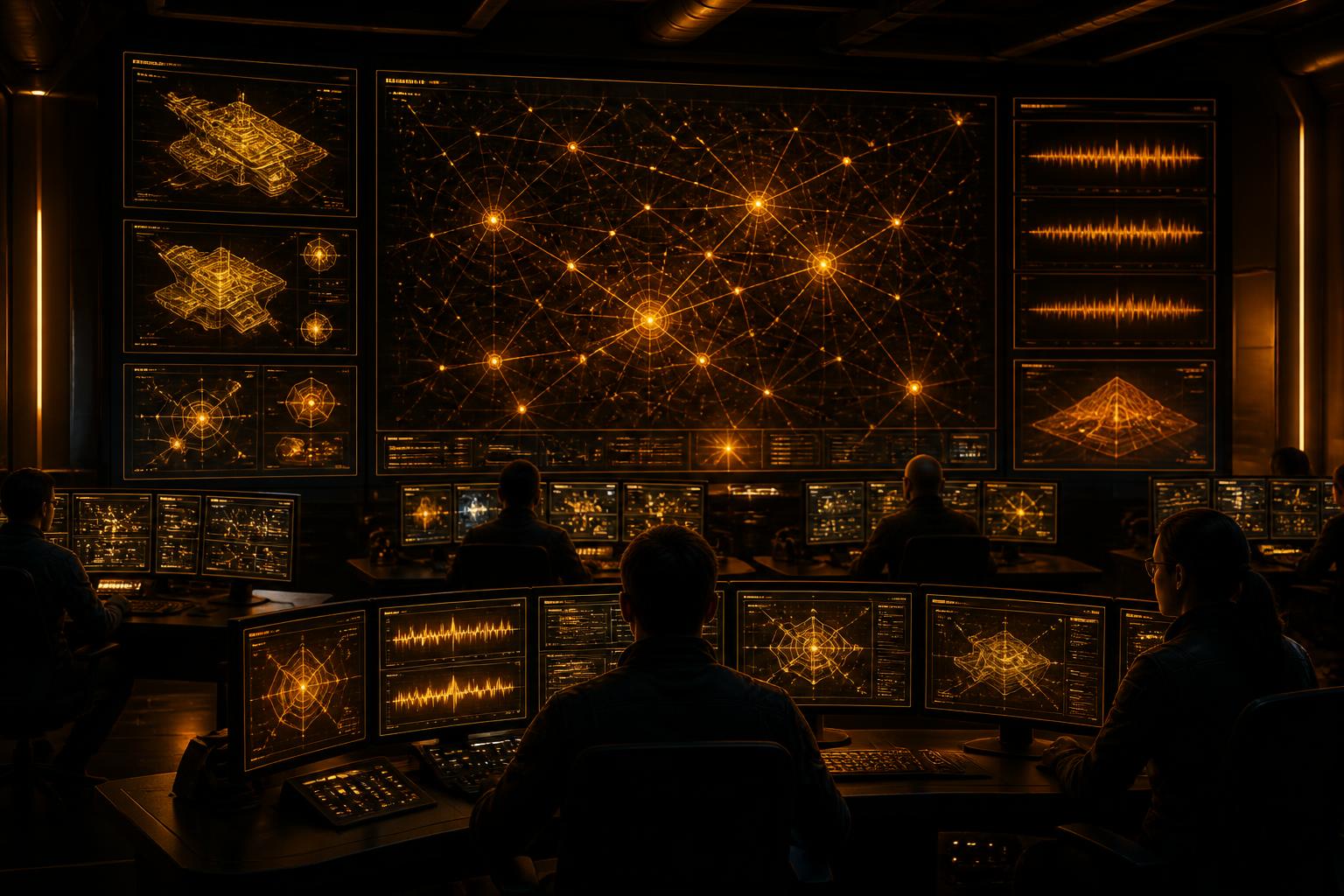
The Digital Instrumentation Layer
Instrumentation Mesh's sensing array is the foundation of the Instrumentation Mesh sensing architecture — the software that touches the surface and the corridor. Instruments fall into three deployment families: platform-embedded agents fixed inside each monitored surface, network-layer taps running analysis on data paths, and field/mobile monitors carried by UNDERTOW field operatives. Every node streams over the Pattern Fabric to GOVERNOR and into the named metrics tracked in the Metrics catalogue.
| Sensor type | What it measures | Where deployed | Sample rate | Linked metric |
|---|---|---|---|---|
| Session probe | Per-surface session load & intraday delta — attention flow, dwell spikes, autoplay drift. | Inline on every instrumented surface session. | 1 / min | Session Dwell |
| Cohort-focus probe | Core cohort attention temperature & compulsion-loop stability. | Cohort interaction layer. | 4 / min | Population Focus |
| Notification cadence monitor | Push notification frequency, recommender churn rate, and engagement escalation patterns. | Surface event & notification path. | Continuous (stream) | Notification Cadence |
| Sentiment pressure sensor | NLP-derived outrage buildup, dissent clustering, and emotional amplification across feed surfaces. | Cohort feed & reply layer. | 2 / min | Dissent Pressure |
| Information diversity index | Source variety, viewpoint breadth, and filter-bubble depth in content delivery to the cohort. | Surface feed delivery gate. | Per feed refresh | Attention-Resource Load |
| Dark-pattern signature scanner | Pattern-signature analysis of dark-pattern residue in flows, consent walls, and entry funnels. | Entry sampling layer & corridor intercepts. | 6 / hr | Dark-Pattern Telemetry |
| Dark-traffic analyzer | Obfuscated data flows, shadow API calls, covert tracking beacons, and extractor intrusions. | Surface entry points & corridor data paths. | 2 fps (event-gated) | Dark-Traffic Activity |
| Relay node | Mesh link health, hop latency, and node power for the surrounding cell. | Corridor relay points & field operative units. | 10 / min | Fabric Latency |
Deployment Families
The same instruments are packaged differently depending on where they operate — embedded in a platform, tapped into a data path, or carried in the field.
Platform-Embedded Agents
Software agents threaded into each monitored surface — session probe, cohort-focus probe, notification cadence monitor, sentiment pressure sensor, information diversity index, and the entry dark-pattern signature scanner. These form the standard instrumentation package on every monitored platform.
Network-Layer Taps
Analysis nodes positioned along data paths and attention corridors — dark-pattern signature scanners at corridor intercepts, dark-traffic analyzers on transit routes, and the relay nodes that knit coverage together between surface sites and across open monitoring ground.
Field / Mobile Monitors
Portable monitoring carried by UNDERTOW field operatives — mobile dark-pattern sampling, dark-traffic scanning, and roving relay nodes that fill coverage gaps and survey corridors no fixed instrument reaches.
Related
The sensing array is one layer of the wider monitoring nervous system.
- Instrumentation Mesh — the three systems, alarm escalation, and mesh health.
- Metrics catalogue — definitions for every metric these instruments feed.
- Live Command Wall — current array and mesh state in real time.